Matter undergoes gravitational collapse toward points whose distribution in spacetime is random, forming black holes. Matter is then heated, which in turn leads to an increase in its volume.
5.1. Spiral, irregular, and dwarf elliptical galaxies
When matter crosses the event horizon of a supermassive (non-rotating) black hole, an explosive event occurs. As a result of this explosion, the central bulge of a spiral galaxy is formed. The remaining matter collapses again, forming a secondary black hole. Matter located above the event horizon collapses and begins to rotate. Large amounts of energy are emitted through thermonuclear reactions. A significant portion of this energy is absorbed by the secondary black hole located at the centre. The previously collapsing matter of the secondary black hole increases its rotational velocity and bulges in the equatorial plane. Receiving large amounts of energy but relatively little additional mass, it ceases to collapse, expands in volume, rotates increasingly rapidly, and flattens. As a result, part of the matter — now rotating — crosses the event horizon in the equatorial plane and remains in the form of spiral arms. Support for this hypothesis may be found in calculations by Richard H. Durisen and collaborators at Indiana University [10], conducted in the context of testing fission theory (formulated by Kelvin) regarding the formation of binary star systems. These calculations showed that matter ejected from a rotating system should remain within it in the form of spiral arms. The time interval between the explosion of the black hole and the escape of matter from the secondary black hole can be estimated by subtracting the age of the oldest stars in the spiral arms from the age of the oldest stars in the central bulge. The remaining matter in the black hole (galactic nucleus) continues to receive large amounts of energy from the central bulge and spiral arms, which may lead to further ejections of pre-stellar matter. This is consistent with the hypothesis of V.A. Ambartsumian concerning the activity of galactic nuclei.
The explosion of a spherical supermassive black hole, and the subsequent energetic processes, leads — as noted — to the emission of vast amounts of energy. A portion of this energy is absorbed (in addition to the secondary black hole) by nearby black holes, which in turn also release matter. This explains the occurrence of galaxies in groups and clusters, as well as the morphological and hence age similarity of galaxies within them. Since non-rotating black holes do not organise structures, the resulting clusters are irregular. Only after an “explosion” do rotating galaxies organise the structures they form, i.e. clusters.
After the explosion of a supermassive black hole, other nearby black holes also undergo similar explosive processes.
After the explosion of (rotating) massive black holes, spiral galaxies without a central bulge may form. The increase in energy within a black hole increases the volume, rotation, and flattening of matter until it crosses the event horizon in the equatorial plane and forms spiral arms. This is supported by the absence of a central bulge in the galaxy M33 (NGC 598). (Incidentally, the presence of a halo suggests that halo stars do not form as a result of central bulge formation.)
From smaller black holes (with matter still rotating) near a supermassive explosion, dwarf elliptical galaxies may form. The factor determining the kind of galaxy that forms is not only mass, but also the amount of energy received per unit mass per unit time. If temperature increases rapidly, a dwarf elliptical galaxy forms. If the matter was rotating, the resulting shape is elliptical; if not, it is spherical. The faster and more intense the increase, the more spherical the resulting structure. Two identical black holes (matter, temperature, rotation) will evolve into differently shaped galaxies depending on their distance from the energy source (supermassive black hole undergoing explosion).
Intermediate-sized black holes may give rise to both types of galaxies. The same initial black hole may produce either a spiral galaxy without a central bulge or a dwarf elliptical galaxy, depending on rotation speed and proximity to the energy source. Closer proximity leads to a faster energy increase per unit mass and hence a dwarf elliptical galaxy. Greater distance leads to slower energy input and a spiral galaxy without a central bulge. Thus, the mass of the smallest spiral galaxies without central bulges may be lower than that of the largest dwarf elliptical galaxies.
In the Gravitational Model of the Universe, the simplified cycle of matter circulation proceeds from a spherical black hole to a spiral galaxy of type Sa (Sba), progressing toward type Sc (Sbc). This hypothesis is supported by the structure of spiral galaxies of types Sa (largest central bulge, tightly wound arms containing young blue stars and neutral hydrogen), Sb (smaller, less distinct central bulge with older red stars and moderately wound arms containing young blue stars), and Sc (no distinct central bulge, light dominated by young blue stars in loosely wound arms).
During spiral galaxy formation, irregular galaxies may also form from detached fragments of spiral arms. The formation of an irregular galaxy from a spiral arm fragment is supported by observations of galaxy M51 (NGC 5194) and its irregular companion galaxy (NGC 5195). The arm connected to the irregular galaxy contains significantly less matter [16], I believe this is a result of its partial transformation into an irregular galaxy.
The hypothesis regarding derivative galaxies — irregular and dwarf elliptical — is also supported by their gas content, shape, relatively low mass, association with spiral galaxies, and stellar composition.
5.2. Lenticular and massive elliptical galaxies
The aging of stars in the central bulge of a spiral galaxy reduces the flow of energy into the black hole within the galaxy while increasing the amount of mass falling into it. The rotational velocity decreases and the spiral arms unwind. A descendant galaxy then forms from the spiral galaxy. There are grounds for considering the lenticular galaxy as such a descendant form, eventually evolving into a massive elliptical galaxy. This hypothesis is supported by its structure (population II stars, components moving along random orbits, and in some cases the presence of interstellar dust), as well as by the occurrence at the centres of rich galaxy clusters and by the emitted radiation [9, 12].
In the Model, I make a clear distinction between massive elliptical galaxies and dwarf elliptical galaxies. The justification for separating these two morphologically similar groups is supported (apart from size and luminosity) by findings presented by Joshua Barnes of the Institute for Astronomy in Honolulu, Lars Hernquist of the Lick Observatory at the University of California, Santa Cruz, and Francois Schweizer of the Carnegie Institution in Washington [12]. Massive elliptical galaxies rotate slowly, whereas dwarf ellipticals rotate more rapidly. No progenitors of dwarf elliptical galaxies have been identified and, because of their velocities, mergers between such galaxies are unlikely, unlike in the case of massive ellipticals. Moreover, dwarf elliptical galaxies — unlike massive ellipticals — are associated with spiral galaxies.
Why are descendant galaxies (massive ellipticals) larger than spiral galaxies? There are two reasons. First, an aging spiral galaxy merges with derivative galaxies. These derivative galaxies age more slowly than the parent galaxy because, owing to their sizes and masses, the process of star formation within them is slower and their stars live longer (being smaller in size). For this reason, we do not encounter, for example, old irregular galaxies. In reality, they are integral parts of larger systems (collectively referred to as supergalaxies). This can currently be observed in our own cluster: the Magellanic Clouds are approaching the Galaxy (which is an intermediate type between Sb and Sc and, therefore, an aging spiral galaxy). This view is supported by Sidney van den Bergh and James E. Hesser (Dominion Astrophysical Observatory, National Research Council of Canada), who argue that the Magellanic Clouds will eventually merge with the Milky Way [11]. The second reason is the merging of aging spiral or lenticular galaxies. This has been confirmed both observationally and theoretically. David Malin of the Anglo-Australian Observatory in New South Wales discovered stellar envelopes surrounding elliptical galaxies, composed of stars approximately 10 billion years old — characteristic of spiral galaxy disks. Further evidence for mergers is provided by the fact that in some elliptical galaxies the central region rotates in the opposite direction to the outer region, while stellar motions are random. These conclusions were supported by computer simulations carried out by researchers including Alan Toomre of Massachusetts Institute of Technology, Juri Toomre of New York University, Peter Quinn of the Australian National University, and Simon White of the University of Cambridge. Studies by Barnes, Hernquist, and Schweizer also support the formation of elliptical galaxies through the fusion of disk galaxies (spiral and lenticular) [11]. Additional support for this scenario comes from the observed approach of the Milky Way toward the Andromeda Galaxy (M31, NGC 224).
During the merger of disk galaxies, part of the matter escapes into intergalactic space as a result of changing gravitational interactions. This matter may later be captured by forming spiral galaxies and give rise to halo stars (as well as meteors, moons, and planets). This explains why halo stars in spiral galaxies are older than the other stars. Observational data support this interpretation: according to Pierre Demarque and David Guenther of Yale University, and Elizabeth Green of the University of Arizona, the oldest star clusters in the Galactic disk are approximately 8 billion years old, whereas — according to Peter Stetson and collaborators from the Dominion Astrophysical Observatory, and Roberto Buonanno of the Astronomical Observatory in Rome — the youngest globular clusters in the halo are approximately 11 billion years old [11]. The existence of a temporal gap between the formation of halo stars and disk stars in spiral galaxies had already been suggested by W. G. Berman and A. A. Suchkov of Rostov University [11], although the explanation proposed in the present Model differs from theirs. Additional arguments for such a gap were also advanced by John E. Norris and collaborators from the Australian National Observatory [11].
The aging of stars in a massive elliptical galaxy results in the production of progressively smaller amounts of energy. The galaxy ages and ultimately collapses into a supermassive black hole. This collapse causes the violent ejection of the outer layers of matter. This process (together with the escape of matter into intergalactic space during the formation and subsequent merger of spiral galaxies) explains why spiral galaxies formed (through a black hole) from massive elliptical galaxies possess, on average, lower masses than massive elliptical galaxies themselves. The ejected matter constitutes a second source for the formation of galactic halos around spiral galaxies.
The Model further implies that galactic halos may be composed of matter originating from galaxies of different ages. This is supported by research by van den Bergh, according to which different halo populations exhibit distinct “chemical signatures.” Michael J. Bolte of the Lick Observatory showed that the cluster NGC 288 is approximately 15 billion years old, whereas NGC 362 is only about 12 billion years old. Additional support comes from the observation that some of the oldest halo stars and clusters move along retrograde orbits [11].
Matter ejected during the collapse of an elliptical galaxy consists, to a greater extent than matter released during disk-galaxy mergers, of heavy elements and therefore constitutes the principal source of planetesimals. Therefore, the matter from which the Earth formed originated not from the parent black hole of the Milky Way, but from another galaxy. This view is supported by estimates of the ages of elements in the Solar System (based on measurements of heavy radioactive elements), which — according to Geoffrey Burbidge of the University of California, San Diego — are approximately 15 billion years old for some components [13], corresponding to the age of the oldest halo clusters in the Galaxy.
Not all matter ejected during collapse into a supermassive black hole is captured by younger galaxies. Some is captured by other black holes or collapses toward its own centre of gravity and merges into smaller black holes. This is another reason why descendant galaxies — dwarf elliptical galaxies — form near exploding supermassive black holes.
In summary, the matter constituting a typical spiral galaxy originates from three sources. The explosion of a spherical supermassive black hole gives rise to the stars of the central bulge, while matter ejected later from the secondary (rotating) black hole forms the stars of the spiral arms. Matter expelled during the fusion of disk galaxies forms the halo stars. The collapse of a massive elliptical galaxy produces (in addition to a supermassive black hole) smaller black holes, halo stars, and planetesimals, followed later by meteors, planets, moons, and comets. Throughout this entire process, mass and energy are continuously exchanged with the surroundings (DIAGRAM 2).
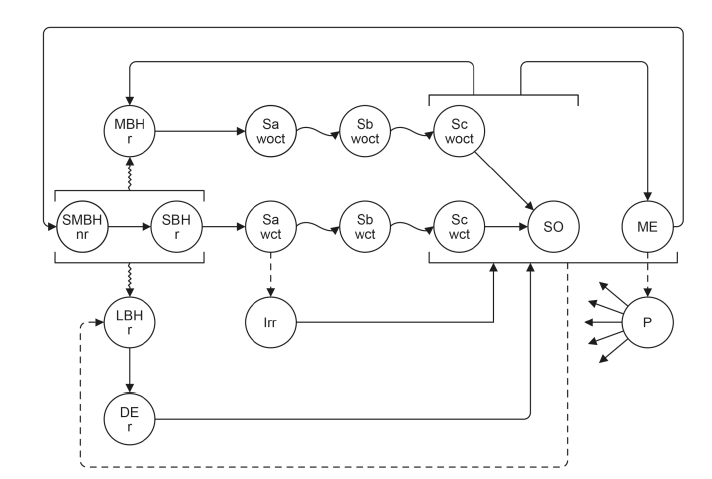
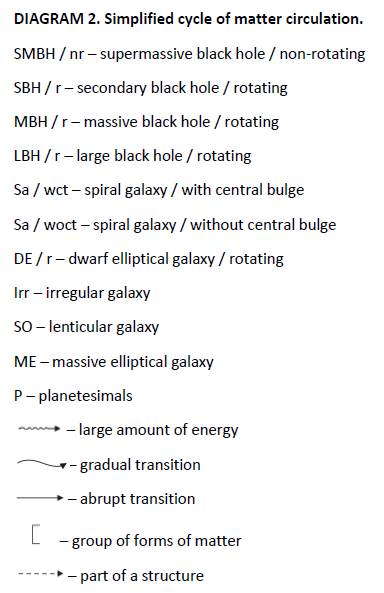
This scenario is supported by the structures of galaxy clusters. Initially irregular clusters (composed of spiral galaxies formed from non-rotating black holes, which do not organise structures because they do not gravitationally interact) gradually organise themselves around a common centre of gravity. During this process, spiral galaxies evolve into lenticular galaxies and ultimately into massive elliptical galaxies, eventually forming regular galaxy clusters. A similar process, though in a different context, was also suggested by Barnes, Hernquist, and Schweizer, who wrote: “Some galaxy clusters (...) are irregular in shape, lack a clearly defined centre, and contain a much higher percentage of spiral galaxies than rich clusters. A brief examination of the irregular Hercules Cluster reveals many interacting galaxy pairs. In billions of years, many of these pairs will most likely merge. During that time, the cluster will evolve and become less irregular. Ultimately, it will resemble a regular cluster containing many elliptical galaxies” [12].
The percentage of mass within the individual forms of matter reflects the relative duration of existence of the matter in a given form in the Universe within the cosmic cycle.