1. A non-rotating black hole, and therefore – in accordance with Roy Kerr’s solutions to the equations of general theory of relativity [4] – a spherical black hole (FIGURE 1), consists of:
- spherical matter with a minimum mass sufficient for this black hole to form (i.e. greater than the Chandrasekhar limit);
- the space between this mass of matter and the event horizon (located at a distance equal to the Schwarzschild radius measured from the centre of this matter) which constitutes a one-way adiabatic isolation.
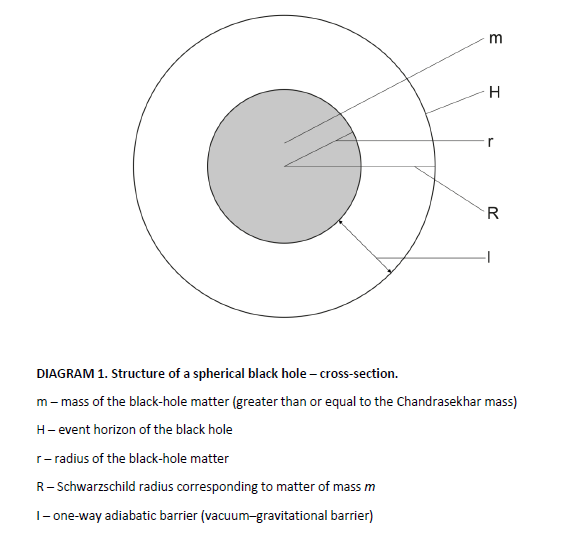
2. When the matter within a black hole rotates, it bulges outward in the equatorial plane, in accordance with Kerr’s solutions [4]. Unless it receives a sufficiently large amount of energy in a sufficiently short time, any rotating matter falling into a black hole will end up in a perfectly spherical state (it does not rotate).
3. The matter of a supermassive, spherical black hole absorbs energy (and mass) from its surroundings. When the ratio of energy to mass is sufficiently high, matter in the form of elementary particles (Ambartsumian’s pre-stellar matter) crosses the event horizon (as a result of heating, the volume of matter has increased) and thermonuclear reactions begin to take place beyond it. We will call this process a black hole explosion. As a result of the loss of matter in the black hole, its Schwarzschild radius decreases, which further increases the amount of mass above the event horizon. The energy-to-mass ratio below the event horizon decreases, causing the remaining matter beneath it to begin collapsing and separating from that above the event horizon. A secondary black hole is formed, in which the collapsing matter spins even faster. It receives enormous amounts of energy from the thermonuclear reactions taking place above the event horizon. The temperature rises. The matter increases in volume once more (the energy-to-mass ratio increases). Flattened by the spinning, it crosses the event horizon – this time in the equatorial plane.
4. The matter still rotating within a massive black hole, when it receives a sufficient amount of energy in a short space of time (from a spherical black hole exploding nearby), increases in volume and rotational speed. The matter crosses the event horizon only in the equatorial plane.
5. The non-rotating matter of a small black hole, when it receives a large amount of energy in a short time, crosses the event horizon in all directions.
6. The rotating matter of a smaller black hole – after receiving a large amount of energy – also crosses the event horizon in all directions, but most of the matter is ejected in the axis of the rotation.
One may ask whether an infinitely large amount of matter must eventually collapse at some point in space-time, since the ratio of energy to mass would not continue to increase. In the Model, such a situation does not occur. The emission of thermal energy in the form of electromagnetic waves is intrinsically linked to matter in space-time. Matter is distributed evenly throughout the Universe, and so is the energy. The speed at which matter moves is always lower than the speed at which the energy moves. Therefore, thermal energy must increase in a black hole more rapidly than mass.
In general, black holes of various sizes (from supermassive to small ones) may explode, but the process depends on several factors:
- the presence or absence of rotation;
- the amount of energy received per unit of mass over a given period of time;
- the mass.
I assume that Stephen Hawking’s hypothesis regarding black hole radiation is incorrect.